Describe the Steps of Muscle Contraction
The motor end-plate is the location of the ACh-receptors in the muscle fiber. Muscle contraction is initiated by signals that travel along the axon and reach the neuromuscular junction or motor end plate.
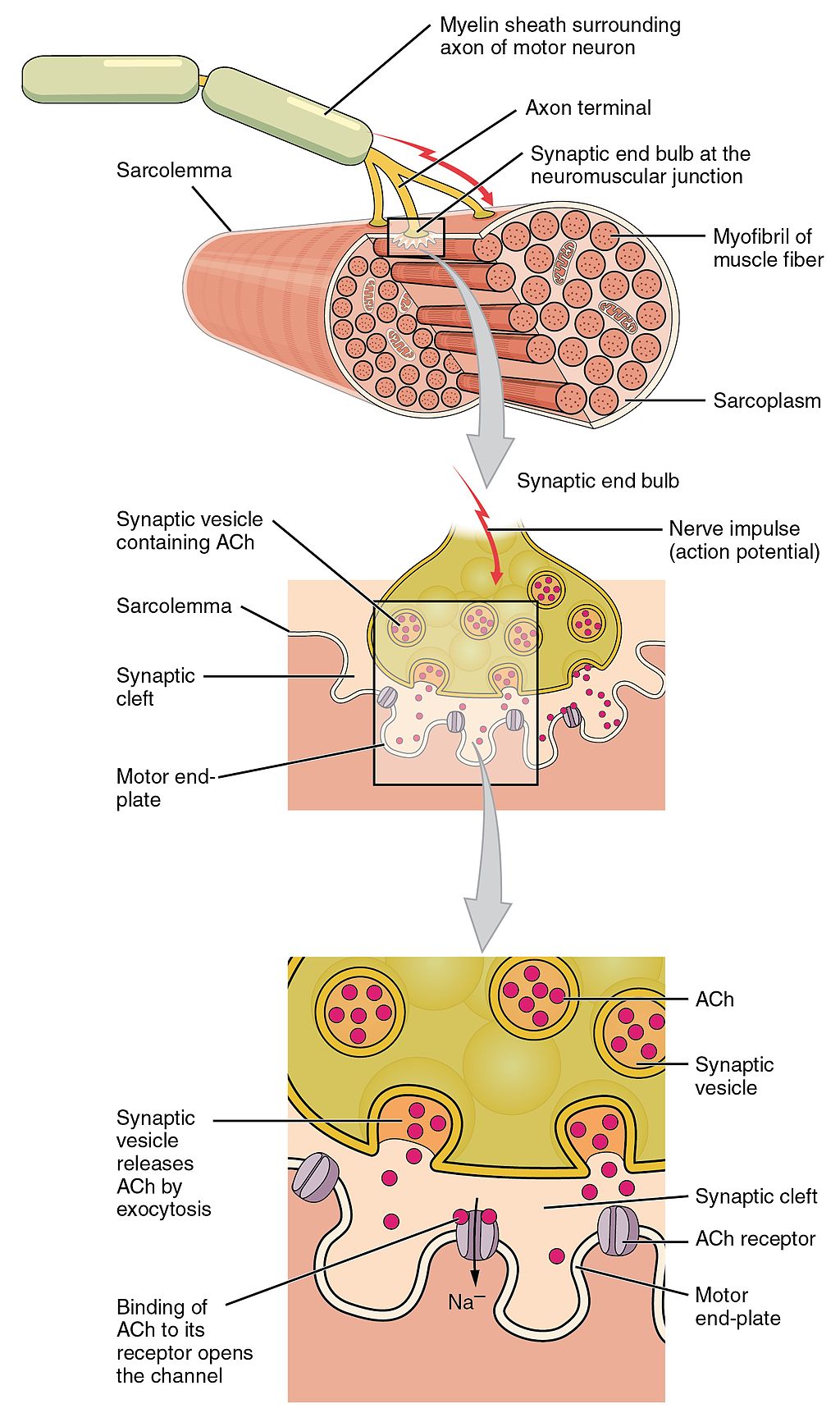
12 4 Muscle Contraction Human Biology
A nerve impulse travels to the.

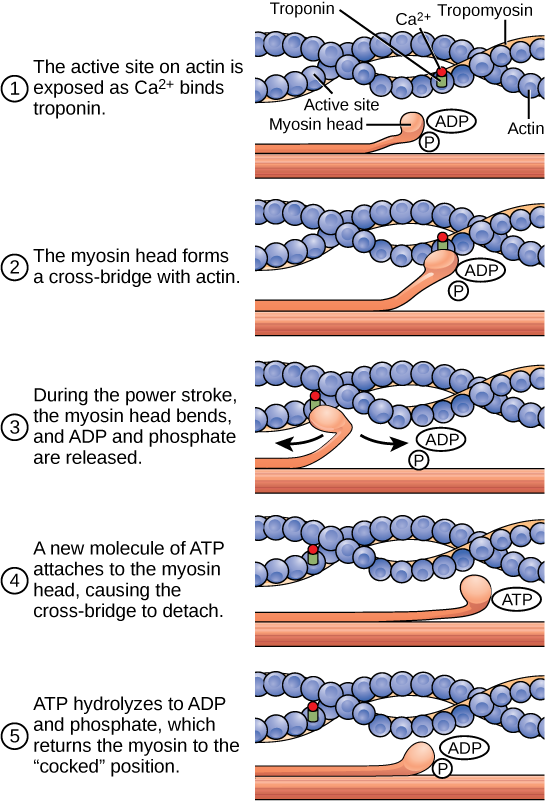
. Steps are as follows. The whole process is called the mechanism of muscle contraction and it can be summarized in three steps. The first step in the process of contraction is for Ca to bind to troponin so that tropomyosin can slide away from the binding sites on the actin strands.
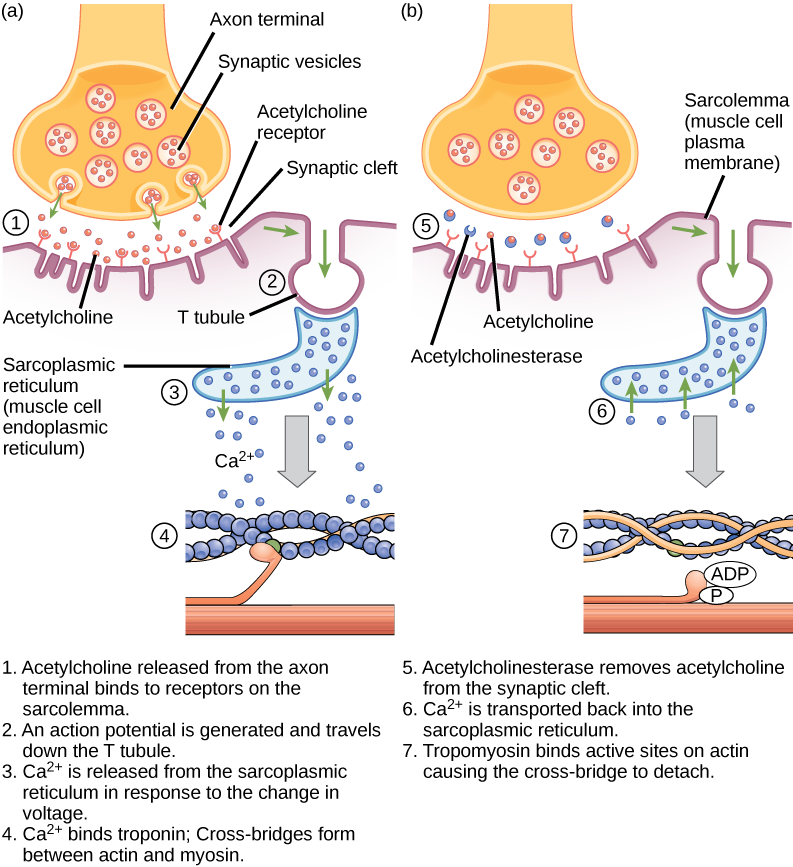
Ach is released from the axon to receptors located on the sarcolemma. The theory of Sliding filament states that the contraction of muscle fibre happens due to the sliding of the thin filaments over the thick filaments. Following are the steps involved in contraction cycle- 1.
The important steps in muscle contraction are given below-- Muscle contraction is begun with the aid of using alerts that travel along the axon and get to the neuromuscular junction or motor end plate. Travelling of signal from axon hillock to axon terminal 3. 2 The chemical reactions lead to the muscle fibers reorganizing themselves in a way that shortens the muscle--thats the contraction.
Ca reaches to Sarcoplasmic reticulum causes the release of stored Ca in SR in cytosol. Step 1 Depolarization of Sarcolemma The central nervous system CNS sends signals through a motor neuron that reaches the neuromuscular joint or the motor end plate. For a skeletal muscle fiber to contract its membrane must first be excitedin other words it must be stimulated to fire an action potential.
2 The chemical reactions lead to the muscle fibers reorganizing themselves in. The axon terminal there will be opening of calcium gated channels which leads to influx of calcium insid. View the full answer.
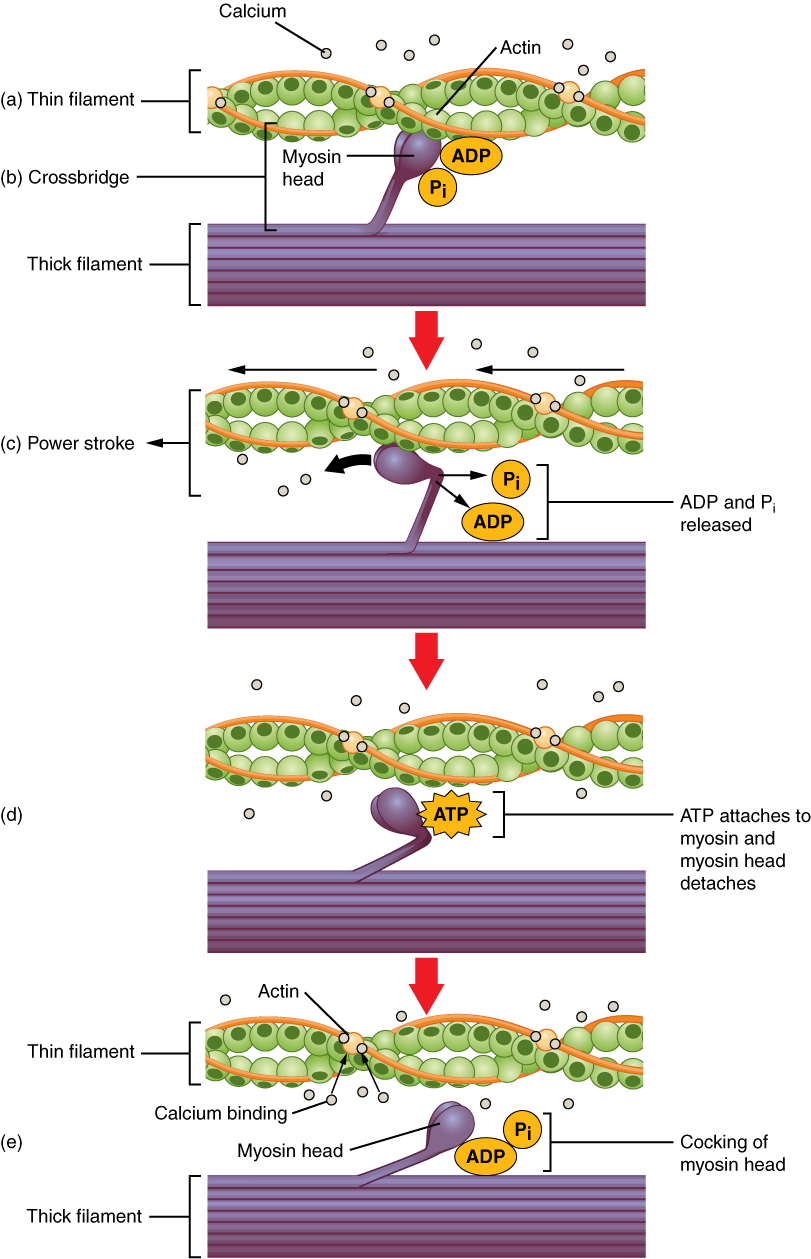
ATP molecules bind and detach myosin and the cross bridges are broken. It is generally assumed that this process is driven by cross-bridges which extend from the myosin filaments and cyclically interact with the actin filaments as ATP is hydrolysed. Calcium floods into the muscle cell binding with troponin allowing actin and myosin to bind.
1 A message travels from the nervous system to the muscular system triggering chemical reactions. As a result acetylcholine is secreted into the synaptic cleft by producing an action potential within the sarcolemma. Actin and myosin slide on each other and causing contraction of the muscles.
Although the term excitation-contraction coupling confuses or scares some students it comes down to this. Generation of action potential at axon hillock 2. Troponin shifts tropomyosin which was blocking the active site on the actin.
Ca2 release from SR terminal Cisterinae binding site exposure. Is the point where the axons of the nerve meet with the muscle cell. ATP causes Myosin head to be released.
Thus the excitation-contraction coupling process begins with signaling from the nervous system at the neuromuscular junction Figure 1031 and ends with calcium release for muscle contraction. Muscle Contraction Steps in Detail AcH binds to the AcH receptors present in the sarcolemma increasing its permeability Na enter the sarcolemma changing its polarity and creating an action potential Ca are released by the sarcoplasmic reticulum as the. Acetylcholine binds with receptors on the cell membrane on the muscle fiber opening Ca2 -Na channels.
Figure 1031 Motor End-Plate and Innervation. The binding Ach causes. This stimulates the sarcoplasmic reticulum to release calcium into the muscle cell.
Release of ADP Pi Causes power stoke. Describe the steps of skeletal muscle contraction from neuron signaling through coupling to power stroke. Myosin cross bridges attach detach pulling actin filaments toward center requires ATP.
ACh is the neurotransmitter that binds at the neuromuscular junction NMJ to trigger depolarization and an action potential travels along the sarcolemma to trigger calcium release from SR. The generation of this action potential releases calcium ions from the. Steps to Muscle Contraction.
SLIDING FILAMENT MECHANISM is used ti describe the contraction and relaxation of muscle. To initiate muscle contraction tropomyosin has to expose the myosin-binding site on an actin filament to allow cross-bridge formation between the actin and myosin microfilaments. Muscle contraction is described by the sliding filament model of contraction.
Usually referred to as Calcium channels. On a muscle cell. ATP HYDROLYSIS- Mysoin head includes an ATP binding site that functions as an ATPase- an enzyme th.
At the NMJ the axon terminal releases ACh. After muscle contraction the myosin head pulls the actin filament and releases ADP along with inorganic phosphate. This allows the myosin heads to bind to these.
The muscle fiber action potential which sweeps along the sarcolemma as a wave is. Calcium binds to troponin. STEPS IN EXCITATION CONTRACTION COUPLING 1.
Describe the important steps in muscle contraction. Action potential generated which stimulates muscle. Calcium is released from the terminal cisternae into the muscle fiber.
3 When the nervous system signal is no longer present the chemical process reverses and the muscle fibers rearrange again and the muscle relaxes. This process of formation and breaking down of cross bridges continues until there is a drop in the stimulus which causes an increase in calcium. Ca binds to troponins for contraction 3.
Terms in this set 6 Step 1. The motor nerve stimulates an action potential impulse to pass down a neuron to the neuromuscular junction. The actin and myosin cross bridges bind and.
When Ca unbinds troponin relaxation occurs. Myosin head binding to actin binding sites. Ca2 binds to troponin shifting the actin filaments which exposes binding sites.
Muscle contraction occurs when the thin actin and thick myosin filaments slide past each other.

7 The Muscular System Ppt Download Muscular System Smooth Muscle Tissue Muscle Performance
6 4 Muscle Contraction Medicine Libretexts

Muscle Contraction Bioninja

Muscle Fiber Contraction And Relaxation Anatomy And Physiology I
Muscle Fiber Contraction And Relaxation Anatomy And Physiology

Steps Of Muscle Contraction Plasma Membrane Muscle Contraction Human Muscle Anatomy Human Anatomy And Physiology

Muscle Contraction Bioninja

Biology Of The Universe Biologyoftheuniverse On Instagram This Image Illustrates The 10 Steps Of Neurom Neuromuscular Junction Neuromuscular Nursing Notes

Muscle Contraction Bioninja
Plasma Membrane Muscle Pelvic Floor

Howstuffworks How Muscles Work Facial Muscles Anatomy Human Anatomy And Physiology Muscle

Muscle Fiber Contraction And Relaxation Anatomy And Physiology I

Muscle Fiber Contraction And Relaxation Anatomy And Physiology I

Muscle Fiber Contraction And Relaxation Anatomy And Physiology I

Physiology Of Skeletal Muscle Contraction Physiology Skeletal Muscle Muscle Contraction

Steps Of Muscle Contraction By Lauren Hoff
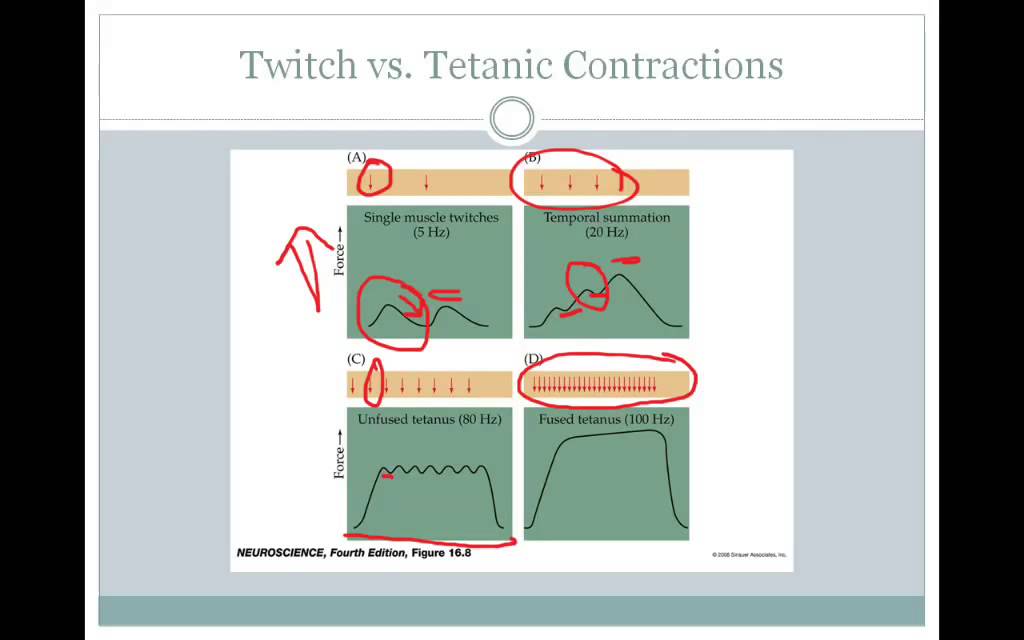
Sjsu Neurophysiology Lecture 9 Motor Neurons And Muscle Contraction Motor Neuron Neurons Muscle Contraction
6 4 Muscle Contraction Medicine Libretexts

1st Year Medical School Physiology Essay Describe The Effects Between The Action Potential Arriving At Neuromuscular Junction Muscle Contraction Neuromuscular


Comments
Post a Comment